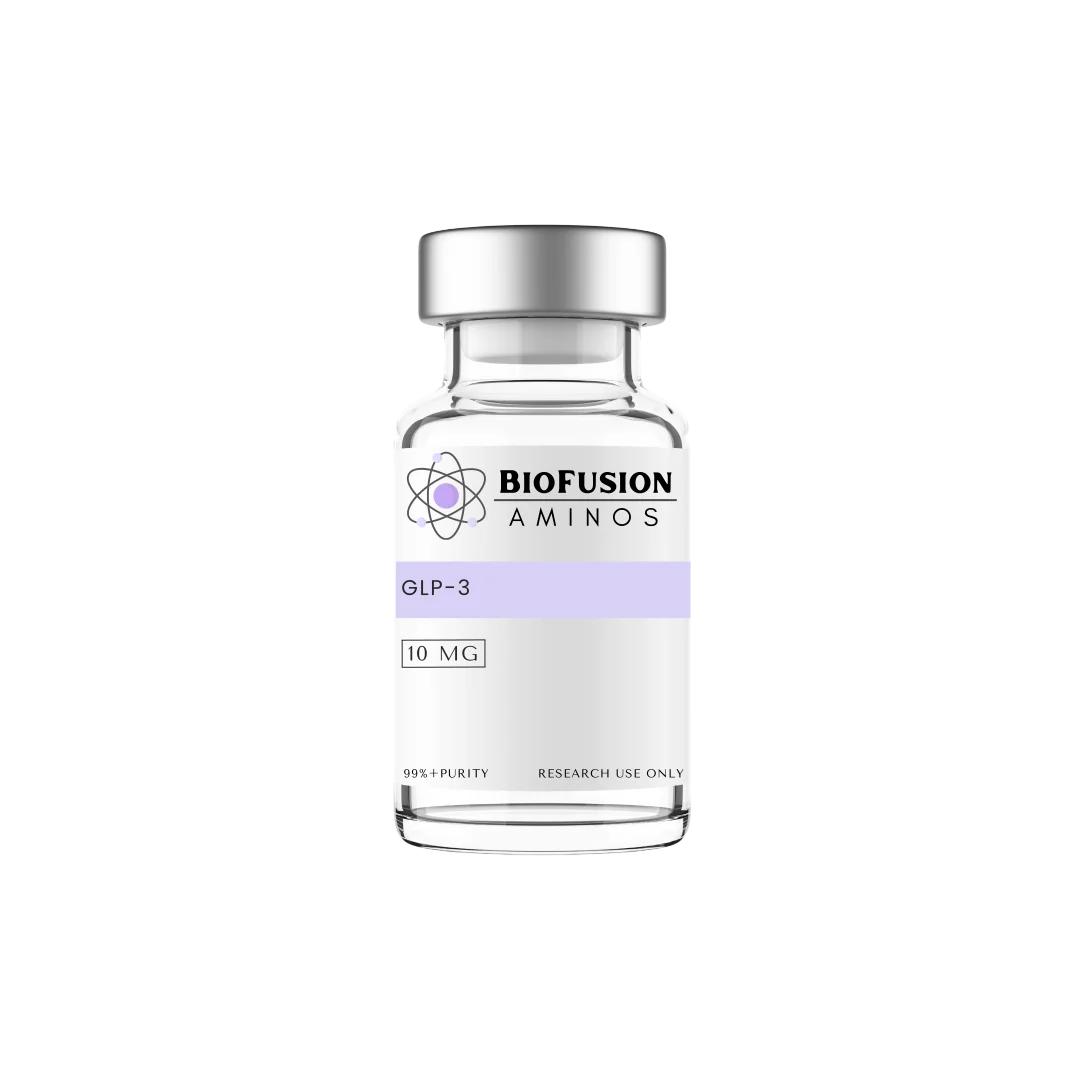

Peptide reconstitution math is simple arithmetic, but a single unit-conversion error can quietly invalidate an entire experiment. Here is the complete walkthrough — and the free BioFusion calculator that does it for you.
The Core Equation
A research-grade peptide ships as a lyophilized powder of known mass (e.g., 5 mg). To use it, you:
- Add a known volume of reconstitution solvent — usually bacteriostatic water, sterile water, or 0.9% saline.
- Calculate the resulting concentration in whatever unit your protocol requires — typically µg per µL or mg per mL.
The math:
Concentration (mg/mL) = Total peptide mass (mg) ÷ Solvent volume (mL)
Or equivalently:
Concentration (µg/µL) = Concentration (mg/mL) (same number, different unit labels)
Worked Example 1: 5 mg vial, 2 mL solvent
- Total peptide: 5 mg = 5,000 µg
- Solvent volume: 2 mL = 2,000 µL
- Concentration: 5,000 ÷ 2,000 = 2.5 µg/µL
- Or equivalently: 5 ÷ 2 = 2.5 mg/mL
Worked Example 2: Withdrawal for a target µg
If the protocol calls for 250 µg of peptide from the 2.5 µg/µL stock:
- Target: 250 µg
- Stock: 2.5 µg/µL
- Volume to withdraw: 250 ÷ 2.5 = 100 µL
For a standard U-100 insulin syringe (100 unit marks = 1 mL = 1,000 µL), 100 µL corresponds to the 10-unit mark. A U-100 tenth-mark corresponds to 10 µL.
Common Pitfalls
- mg ↔ µg confusion. 1 mg = 1,000 µg. A missed factor-of-1000 is the most common lab math error.
- mL ↔ µL confusion. 1 mL = 1,000 µL. Same factor, different unit.
- Insulin-syringe marks. On a U-100 syringe, each unit corresponds to 10 µL — not to a mg. Always back-calculate from concentration to µL to syringe units.
- Assumed 100% potency. A 5 mg vial contains 5 mg gross peptide + counterion + moisture. For research chemistry studies requiring absolute potency, correct for TFA content and moisture per the COA.
- Evaporation and transfer loss. Small-volume transfers (< 10 µL) lose 5–15% to pipette hold-up. For sub-µL math, plan for a 1.1× overfill.
Why Use the Calculator
The BioFusion peptide reconstitution calculator handles all the above in one screen:
- Input: vial mass (mg), solvent volume (mL), and your desired unit output.
- Output: concentration, µL per µg, and suggested syringe marks for common insulin syringes (U-40, U-100).
- Bonus: a separate mcg-to-IU conversion for compounds that are historically dosed in IU (HCG, IGF family).
No registration, no fluff, no dosing guidance — just chemistry math.
Storage After Reconstitution
Once a peptide is reconstituted, stability decreases. General rules (specific to the peptide, see the COA):
- 2–8 °C in dark conditions: typically 7–21 days for most peptides.
- Freeze-thaw cycles: minimize. Aliquot reconstituted peptide into single-use volumes if the protocol spans more than a week.
- Bacteriostatic water adds 0.9% benzyl alcohol — useful for multi-draw research vials, but reduce to sterile water if the study requires benzyl-alcohol-free conditions.
Related Reading
- Free Peptide Reconstitution Calculator
- Cold-Chain Storage for Research Peptides
- How to Read a Peptide Certificate of Analysis
Laboratory research use only. This article covers chemistry math for in-lab handling of reference standards. It is not dosing guidance for any non-research application.