
The triple-incretin (GLP-1 + GIP + glucagon receptor co-agonist) class is the fastest-growing reference-peptide research segment going into 2026. Here is a chemistry-first walkthrough for research chemists deciding whether to add a triple-incretin reference standard to their catalog.
From single to dual to triple incretin
The incretin research category has evolved across three generations of reference compounds:
- Single-incretin (GLP-1 receptor agonist) — the semaglutide-class reference profile. GLP-1 5mg lyophilized in the BioFusion catalog.
- Dual-incretin (GLP-1 + GIP receptor co-agonist) — the tirzepatide-class profile. GLP-2 5mg lyophilized.
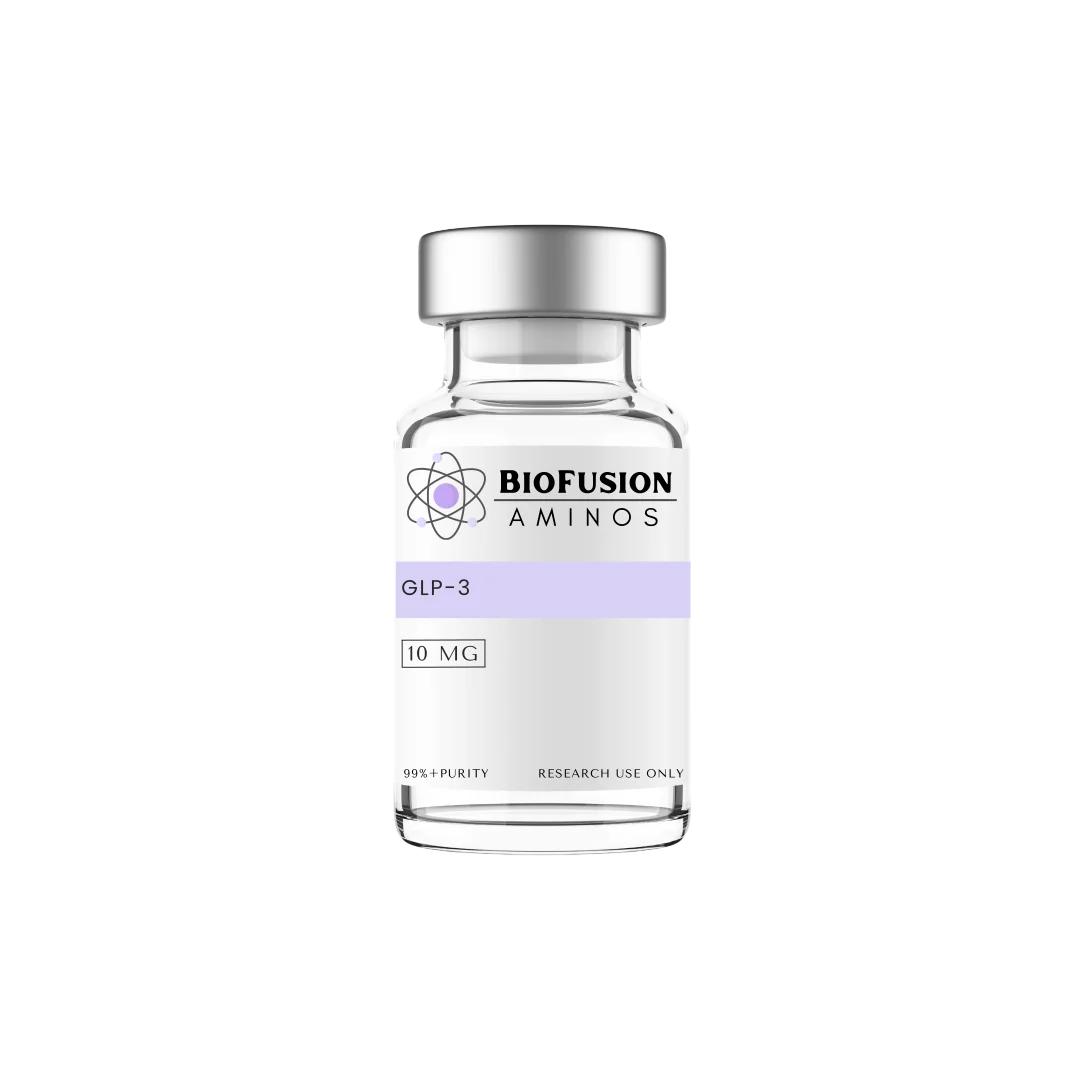
- Triple-incretin (GLP-1 + GIP + glucagon receptor co-agonist) — the retatrutide-class profile. GLP-3 10mg lyophilized.
Adding the third receptor (glucagon-receptor activation) extends the incretin-class research framework into a new pathway-mapping dimension. Background on the incretin chemistry is in our GLP-1 chemistry primer.
What makes triple-incretin synthesis hard
Triple-incretin analogs are exceptionally demanding to synthesize correctly. The combination of long sequence length (39+ residues), specific structural modifications at multiple positions, and side-chain conjugation pushes Fmoc solid-phase peptide synthesis close to its upper bound. Common failure modes:
- Single-residue deletion impurities — produce off-spec batches that pass mass-spec only on the parent peak.
- Incorrect side-chain conjugation chemistry — the modification lands on the wrong residue.
- Diastereomer formation — non-natural residues racemize during coupling.
- Incomplete coupling — especially in the proline-rich middle regions.
For a deeper dive on why Fmoc dominates the modern manufacturing landscape, see our Fmoc vs Boc primer.
Reference verification: what to demand from a supplier
For triple-incretin references specifically, the verification bar is higher than for shorter peptides:
- Identity by LC-MS at the canonical retatrutide-class molecular weight, with no truncation peaks.
- Reverse-phase HPLC purity ≥99.0% — with the chromatogram visible on the lot COA. Our HPLC purity primer covers what to look for.
- Counter-ion analysis by ion chromatography to verify TFA vs acetate salt form, which affects gross mass per vial.
- Karl Fischer moisture to verify the labeled mass is delivered.
- Synthesis-date metadata — published per-lot on the supplier’s batch transparency ledger.
Where the triple-incretin class fits in research
The retatrutide-class profile is the canonical comparator in research panels covering:
- Comparative receptor-binding-affinity studies across the GLP-1, GIP, and glucagon receptor families.
- Metabolic-pathway-mapping research where multi-receptor activation is being studied.
- Cross-class incretin research panels paired with GLP-1 single-class and GLP-2 dual-class references for full-generation comparison.
What BioFusion supplies
The BioFusion GLP-3 10mg lyophilized reference standard is the retatrutide-class triple-incretin research peptide, produced by solid-phase Fmoc synthesis in a U.S.-based ISO 9001:2008 facility. Every lot is verified for identity (LC-MS), purity (HPLC ≥99.0%), moisture (Karl Fischer), and counter-ion (ion chromatography). The signed Certificate of Analysis ships with every order; full lot history archived in the COA library.
Cross-research links
- Browse the full GLP / Incretin class
- How to read a peptide COA
- Choosing a U.S. peptide supplier
- State of the Peptide Industry — Q2 2026 report
External references
For research and laboratory use only.