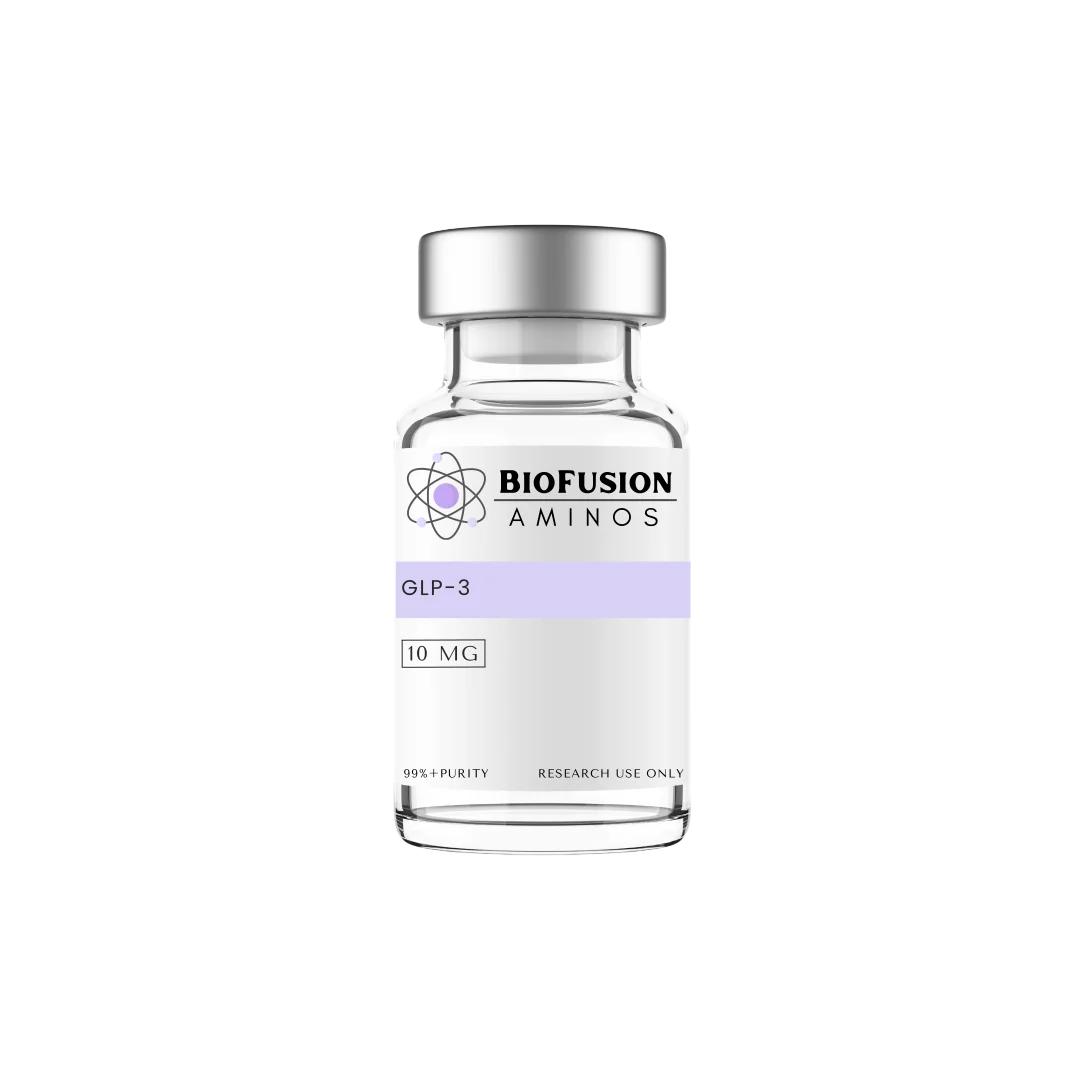
GLP-3 Chemistry: Incretin-Class Research Analog
A bench-level reference sheet on how this single-chain, incretin-class research analog is assembled and characterized, and what to read off it before keeping one as a laboratory reference standard.
Sequence and Structure
GLP-3 is a research designation for a single-chain, incretin-class research peptide supplied as a laboratory reference standard. As a single linear chain it sits comfortably in the size range where modern solid-phase synthesis is routine rather than exceptional, which is part of why it can be prepared and held as a defined reference material. The name groups it with the wider GLP analog family on the basis of its incretin-class design rather than any single fixed canonical sequence.
Because GLP-3 is a research designation rather than an approved compound, the practical takeaway for a research chemist is to treat the sequence on the documentation as the reference of record, and to read its handling behavior from the chemistry rather than from the name. The points that matter on paper are chain length, any C-terminal modification, and the presence of substitutions that change solubility or coupling difficulty. Those features, not the label, are what govern how the material behaves on the column and in the freezer.
Origin and Family
GLP-3 is treated as a member of the incretin class, the same family of gut-derived peptides that gives the GLP analog catalog its name. That family resemblance is useful because it explains why analogs across the group tend to respond to the same synthetic and analytical methods. Reading GLP-3 as part of that lineage, rather than as an isolated molecule, makes its behavior easier to anticipate from the outset.
Within the catalog GLP-3 sits alongside better characterized reference points such as semaglutide and the multi-agonist retatrutide. Treating these as a family rather than as unrelated entries is the most efficient way to approach a newer designation like GLP-3, since the methods proven on the established analogs transfer cleanly to it. The broader incretin context is covered in the GLP analog section of the Research Overviews.
Synthesis by Fmoc SPPS
As a single linear peptide, GLP-3 is well suited to Fmoc solid-phase peptide synthesis. The chain is long enough to demand careful coupling but short enough to assemble in a single linear build without native chemical ligation. Fmoc chemistry uses base-labile protection and mild acidic cleavage, which keeps acid-sensitive residues and any modified positions intact through the assembly.
Coupling efficiency is the variable that most shapes final purity. Difficult sequences in this class can aggregate on resin during chain assembly, so research-grade routes lean on optimized activators, careful resin loading, and where needed pseudoproline or backbone-protected building blocks to keep each coupling clean. Any side-chain or terminal modification carried by a given GLP-3 preparation is introduced on-resin as part of the same linear build. The general comparison of solid-phase strategies is covered in our overview of Fmoc and Boc synthesis.
Characterization (Method)
Identity and purity for GLP-3 are established with the same two complementary tools used across the reference catalog. Reversed-phase HPLC reports the purity figure, the percentage of total peak area attributable to the target peptide, and it separates the main product from closely related deletion and truncation sequences. Mass spectrometry confirms identity by matching the measured mass to the expected mass for the sequence on the documentation.
Reading these two together matters. An HPLC purity number describes how much of the sample is the intended peptide relative to other UV-absorbing species, while the mass result confirms that the main peak is in fact the right molecule rather than a same-length impurity. Both pieces of information describe the chemistry of a given sequence, and a research chemist should expect to interpret them together. Documentation describing these methods is available on request for the laboratory record.
Stability and Storage
As a lyophilized powder, GLP-3 is comparatively stable when kept cold, dry, and out of light. Long-term storage of the dry solid is typically at freezer temperatures, with the container protected from moisture so the hygroscopic powder does not pick up water on opening. Allowing a sealed vial to reach room temperature before it is opened helps avoid condensation on the cold contents.
Once reconstituted, the working solution is far less forgiving. Peptides in solution are subject to hydrolysis, oxidation, and adsorption to surfaces, so reconstituted material is generally held cold and used within a short window, with freeze-thaw cycles minimized. These are general handling principles for research peptides rather than claims about any one preparation, and the documentation for a given standard should be the reference of record for its own conditions.
What GLP-3 Is Studied For (Chemistry Only)
In a research-chemistry context, GLP-3 is of interest as a tractable model within incretin-class structure-activity work. As a defined single-chain analog it lets chemists study how sequence edits, terminal modification, and chain length change a peptide's stability, solubility, and chromatographic behavior, and it serves as a reference point when validating synthesis and analytical methods on related compounds in the GLP family.
That framing is deliberately limited to the bench. GLP-3 is a research designation, not an approved drug, and is supplied as a reference standard for laboratory research only. Nothing here describes or implies any human or veterinary use or outcome. Its value to a research chemist is as a chemistry subject, one entry in a set of related incretin-class sequences whose behavior under synthesis, analysis, and storage is worth knowing in detail.
This overview is provided for laboratory and research use only. It is educational chemistry reference material and is not for human or veterinary consumption. GLP-3 is a research designation, not an approved drug. Buyers are responsible for compliance with all applicable laws and regulations.
GLP-3 chemistry, answered
GLP-3 is a research designation for a single-chain, incretin-class research analog supplied as a laboratory reference standard. It is grouped with the GLP analog family on the basis of its incretin-class design. It is not an approved drug and is offered for research use only, with no human or veterinary use.
As a single linear peptide, GLP-3 is assembled by Fmoc solid-phase peptide synthesis. Identity and purity are confirmed by reversed-phase HPLC, which reports the purity figure and separates the target from related sequences, and by mass spectrometry, which matches the measured mass to the expected mass for the sequence.
As a lyophilized powder, GLP-3 is comparatively stable when kept cold, dry, and out of light, with long-term storage of the dry solid typically at freezer temperatures. Once reconstituted, the working solution is far less stable and is generally held cold, used within a short window, and protected from repeated freeze-thaw cycles.
GLP-3 is treated as a member of the incretin-class family alongside reference analogs such as semaglutide and retatrutide. Reading it as part of that family helps a research chemist anticipate how it behaves under the same synthetic and analytical methods used across the GLP analog catalog.