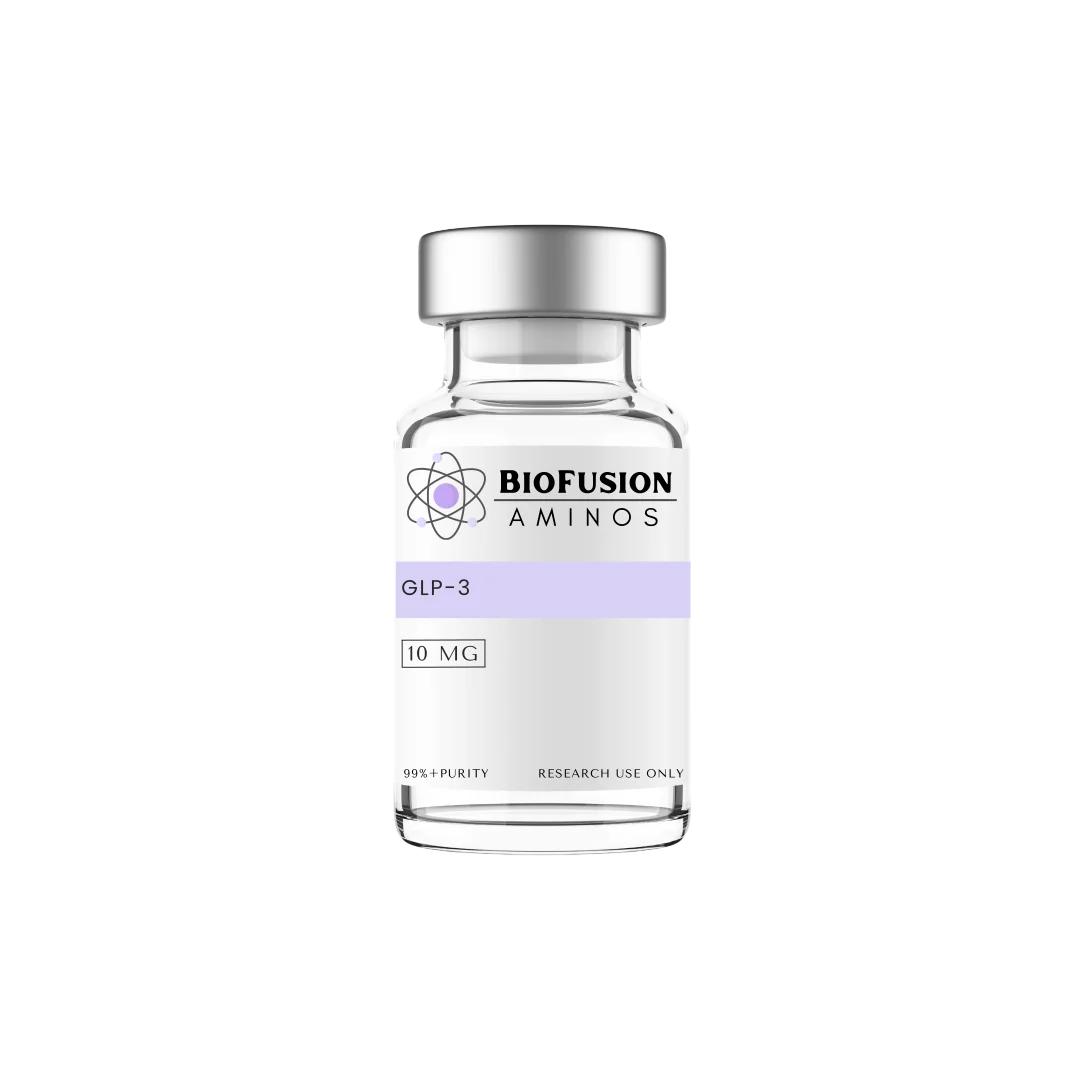

Tirzepatide is one of a small but growing class of dual-incretin receptor agonists — peptides engineered to engage both glucose-dependent insulinotropic polypeptide (GIP) and glucagon-like peptide-1 (GLP-1) receptors with a single molecule. This reference walks through the chemistry that makes that possible, with a focus on what laboratory-procurement teams should know when sourcing tirzepatide reference standards for in vitro work.
Sequence and Architecture
Tirzepatide is a 39-amino-acid peptide built on the GIP backbone with strategic substitutions at positions that stabilize the molecule against dipeptidyl-peptidase-4 (DPP-4) cleavage and tune receptor selectivity. The N-terminus is preserved as the GIP signature, while the mid-sequence and C-terminal regions are modified.
The core engineering moves are:
- Aib substitutions at positions 2 and 13 — alpha-aminoisobutyric acid replacements that block proteolytic cleavage and confer the long half-life required for reference-grade stability work
- Lysine-20 fatty-acid conjugation — a C20 diacid fatty-acid chain attached via a glutamic-acid-AEEAx2 linker, providing albumin-binding behavior
- Receptor-tuning substitutions through the C-terminal region that balance GIP vs GLP-1 receptor affinity
The result is a peptide that retains potent dual-incretin agonist activity while exhibiting the in vitro stability profile that allows it to serve as a usable reference standard for receptor-binding assays, structure-activity exploration, and analog development.
Synthesis Pathway
Tirzepatide is produced by solid-phase peptide synthesis (SPPS), typically Fmoc chemistry on a Wang or Rink-amide resin. The 39-residue chain is built C-to-N, with the lysine-20 side-chain protection scheme allowing selective deprotection for the fatty-acid conjugation step at the appropriate point in the assembly.
Three synthesis steps require special attention:
One — The Aib couplings. Alpha-aminoisobutyric acid is sterically hindered and couples slowly. Most reputable manufacturers use double-coupling protocols at positions 2 and 13, with extended coupling times and HBTU/HATU activation to ensure quantitative incorporation.
Two — The lysine-20 side-chain elaboration. The fatty-acid arm is built off the lysine epsilon-amine via the AEEAx2-glutamic-acid linker before the C20 diacid is conjugated. Each step requires orthogonal protecting-group strategy and HPLC verification before proceeding.
Three — The global cleavage and deprotection. Tirzepatide carries multiple acid-labile protecting groups, and the fatty-acid arm is sensitive to over-cleavage. Standard TFA cocktails (TFA/water/triisopropylsilane) need careful timing.
Verification on the COA
For research-reference work, a tirzepatide COA should include:
- HPLC purity ≥99% (single principal peak, area percent)
- Mass-spectrometry confirmation matching the molecular weight (≈ 4,813 Da)
- Net peptide content corrected for TFA counter-ion and residual water
- Sequence verification (typically by amino-acid analysis or peptide mapping)
- Appearance, solubility, and storage recommendation
Buyers should ask to see the chromatogram, not just the purity claim. The shape of the principal peak matters: a clean, symmetrical peak with no shoulder is the expected output of well-controlled SPPS. A peak with shoulders or a tailing edge suggests incomplete coupling, partial truncation, or fatty-acid-arm heterogeneity.
Storage and Stability Considerations
Lyophilized tirzepatide is stable at -20 °C for the lot’s shelf-life window. Once reconstituted, the working solution should be aliquoted, stored at -80 °C, and avoided through repeated freeze-thaw cycles. The fatty-acid arm is the most heat-sensitive feature of the molecule — sustained warm storage or repeated thaw events will degrade the conjugation faster than the peptide backbone itself.
What This Means for Procurement
Tirzepatide is a structurally complex peptide. The HPLC purity claim is necessary but not sufficient — the chromatogram, the mass-spec confirmation, and the net-peptide-content number together describe what the lab is actually receiving. A supplier that provides all three on the COA is operating at research-grade transparency. A supplier that hides one of the three is asking the lab to take chemistry on faith.
For laboratory and research use only. Not for human or veterinary consumption. Not intended to diagnose, treat, cure, or prevent any disease.